98%
of words on a page you need to know before reading feels comfortable without a dictionary
Vocabulary research (Paul Nation, 2006)
Choose MeloLingua if audio-only drills leave you guessing at meaning or spelling. Choose Pimsleur if hands-free recall practice is the whole job.
Pimsleur is disciplined audio training. MeloLingua keeps deliberate listening but anchors it to readable stories, vocabulary support, and speaking reps that recycle the same meaningful lines.
Written by our language team· Updated · How we write comparisons
Source and disclosure: MeloLingua publishes this comparison and appears in it. Product facts are checked against official sources; recommendations are editorial judgments about how each app fits a learning routine, not controlled evidence that one app produces better outcomes.
By the numbers
Reading and listening inside a story — with help when you need it — helps many people remember words better than flashcards alone.
98%
of words on a page you need to know before reading feels comfortable without a dictionary
Vocabulary research (Paul Nation, 2006)
95%
known-word coverage is a practical minimum for supported reading, but still leaves frequent unknown words
Vocabulary research (Paul Nation, 2006)
A1–B2
the current level range used for MeloLingua story sessions and public graded readers
MeloLingua product fact · verified August 13, 2026
Side by side
This table compares how you actually practice — not brand hype. We say where Pimsleur still wins; see the verdict cards below.
MeloLingua vs Pimsleur — side-by-side comparison
| Topic | MeloLingua | Pimsleur |
|---|---|---|
| Reading layer | Bilingual paragraphs accompany narration | Minimal reading scaffolding |
| Listening practice | Narration spans story arcs | Short spaced-recall prompts dominate |
| Speaking drills | Listen and repeat aloud reps reuse fresh story lines | Audio repetition prompts encourage mimicry |
| Content shape | Stories sustain context and motivation | Lesson stacks recycle cue-response drills |
| Best fit | Learners who need eyes plus ears aligned | Hands-free commuters prioritizing audio recall |
Audio to readable immersion
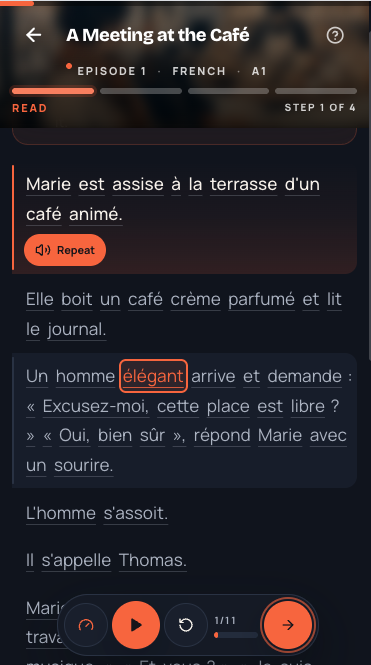
MeloLingua keeps the discipline of listening practice while giving learners enough text support to avoid guessing blindly.
1
Readable scaffolding turns sound into analyzable language.
2
Narration gives natural rhythm and stress.
3
Tap support prevents confusion from hardening into bad guesses.
4
The spoken rep belongs to a scene, not a floating prompt.
Original angle
For many learners, seeing the sentence converts vague recognition into durable vocabulary and syntax.
Clarity
Learners can notice endings, spelling, and word boundaries that audio may blur.
Retention
A line tied to a character or setting is easier to retrieve later.
Pronunciation
Repeating story lines keeps rhythm and meaning together.
What Pimsleur is
Pimsleur is an audio course method built around 30-minute listen-and-repeat lessons with spaced recall prompts. You move through connected lessons completely hands-free — text and extended reading are minimal by design.
Real situations
These are realistic learner situations — not every switch means canceling your current app.
Audio-only practice often produces oral fragments without orthographic anchors. After a commute lesson, open a MeloLingua story segment: see the lines, hear narration again, tap glosses for gaps. Text disambiguates endings and word boundaries audio may blur.
Spanish texts with audio →This pairing works well: Pimsleur hands-free in transit, MeloLingua visual reinforcement at home. Seeing a sentence you heard helps cement grammar and spelling.
Translate-in-context demo →Audio prompts lack a scene to hang on to. Story lines attach to characters and settings — hooks that help memory. Research often shows 30–40% better word recall in context vs. isolated lists.
Read Spanish stories online →Research note: Audio-only courses build listening reflexes; readable stories let you see spelling and grammar. Aim for passages where you know most words (about 85–95%), then use narration to link sound to text. MeloLingua keeps both on the same lines — Pimsleur-style discipline plus visible sentences.
Who should pick what
Pimsleur: Hands-free audio remains useful when looking at text is impossible.
MeloLingua: The readable story catches what audio-only practice can leave blurry.
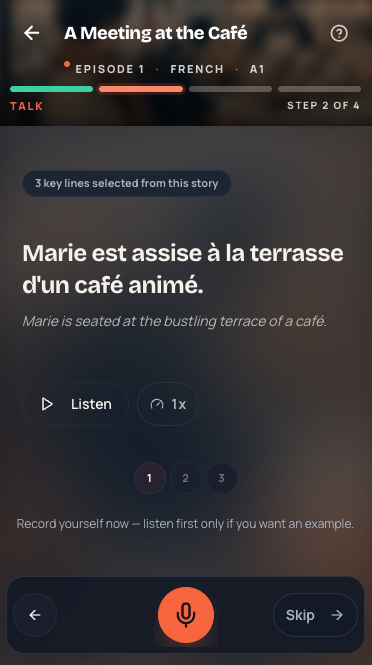
MeloLingua: Speaking reps reuse lines from the story rather than isolated cue chains.
Related guides
If Pimsleur is close but not quite right, these guides cover the next apps people usually try.
Try MeloLingua
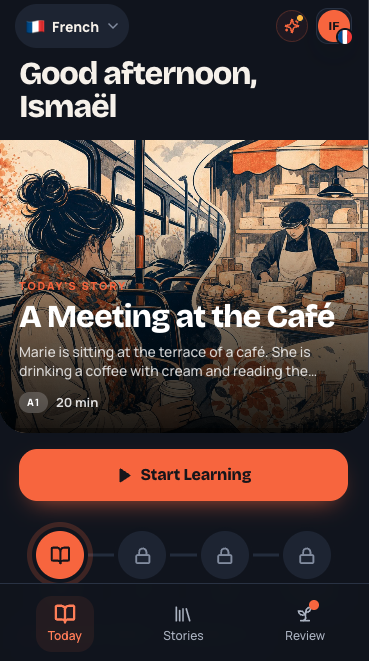
Open a graded passage, hear the story narration, and move from reading to speaking on real A1–B2 content. These are current product screens, not concept artwork.
Learn the method
Our comparisons draw on published research about reading in context, learning words through stories, and building a daily habit — with sources linked below.
Answers
MeloLingua is a strong Pimsleur alternative because it pairs narration with readable story text, vocabulary support, and pronunciation practice.
Pimsleur centers audio-only recall prompts. MeloLingua centers stories where learners read, listen, understand vocabulary, and repeat lines aloud.
Yes. Listening stays central, but it is paired with readable text so learners can understand and later speak the same lines.
MeloLingua helps by giving learners narrated story lines to shadow and repeat with guidance.
Yes. Use audio-first practice when hands-free, then use MeloLingua to reinforce meaning, text, and pronunciation.
MeloLingua is built for learners who want daily exposure to compound into comprehension, vocabulary recall, and clearer spoken sentences.
Review these words right before you would forget them